NHL
Posts tags NHL
Mental Success Factor: Dedication to the Game
Guest Writer: Brent Allen
***
He dekes passed one defender, then the other and takes it in on the goalie. He winds up, fires, goal! In hockey scoring goals takes much more than pure raw talent. If raw talent were the only thing that made a successful hockey player then there would be a very overcrowded NHL. But there is something else that goes into making an athlete successful at the NHL level, and that is what the athlete brings to the table mentally. Rick Nash, of the Columbus Blue Jackets, has been putting up all-star numbers for almost his entire NHL career. To go along with his talent for the game, Nash brings some mental aspects that help him stay amongst the top players in the NHL today.
Rick Nash possesses dedication, which helps him continue to succeed in the NHL today. Nash started playing organized hockey at the young age of ten with the Toronto Marlboro’s triple-A team. He began to develop the various skills needed to be a successful hockey player. Nash continued to work hard to better his skills and this dedication helped him make his debut in the NHL in 2002, where he continues to grow and succeed at the top level. Nash would not have had the drive to push himself to succeed without being dedicated to the game of hockey. This dedication for the game pushed Nash to better himself as a hockey player.
Without having passion for the game of hockey, Nash would probably not be where he is today. Rick Nash’s passion for hockey is knowing that without hockey he would not be complete. This passion is what led Nash to Europe during the NHL lockout in 2004-2005. He could have taken the season off, but Nash enjoys the game too much and he wanted to continue to better his skills. If Nash did not have a passion for the game then there would be no reason for him to put so much time and effort into the game of hockey.
Nash also shows strong determination when on the ice. After a decent rookie season, Nash stepped up his play during the 2003-2004 season where he tied for the league lead in goals scored. Instead of being satisfied with his rookie season totals, Nash’s determination to succeed helped him get to where he is at now. Every time he steps onto the ice, Rick Nash makes sure that he leaves everything out there.
Having strong mental abilities to go along with a strong athletic core, helps make an athlete that much more successful. Rick Nash’s dedication, passion, and determination have helped him achieve various accomplishments, such as the gold medal at the winter games last year. Being strong mentally, as well as physically, will help make for a successful athlete in the long run.
Read More...First Impressions – Make them count
As we prep for Day 1 of testing at the NHL Combines, many of the players have already undergone several interviews with prospective teams. These interviews are opportunities for GMs and Player Directors to get to know the players on a personal level. Teams have had plenty of opportunities to evaluate a prospects playing ability, yet most have not had a chance to meet with players in a 1-on-1 setting. Thus, creating a great first impression is paramount and could be a key factor in getting drafted.
The ability to create a good first impression is something that everyone should aspire to do. You want to be yourself, present yourself appropriately, be polite, smile, and be confident.
As many of you will be attending summer college camps, showcases, tournaments, and visiting colleges this summer, it is essential that you carry yourself appropriately. The college hockey coaching world is small and coaches talk to each other about prospects all the time. So its important to work hard, compete, and be on your best behavior at all times – you never know who might be watching. You only have one chance to make a good first impression and whether or not people admit it, they are judging you and forming an opinion of you the moment you first enter their lives.
Read More...Olympic Results Take Time – A Recap of Team USA’s Hockey Success
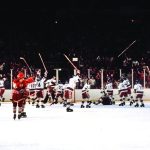
Watching the men’s hockey tournament at the 2010 Olympics has been thrilling. I know it’s easy to say in hindsight that I had a good feeling about that team, but really, I did. I promise. We are actually pretty fortunate in that we have been able to evaluate many of the players on Team USA at some point or another through our work with NHL teams or with the player directly when his agent or coach purchased our services. Given our experience working with athletes at this level, we’ve done a lot of research into what it takes to achieve that kind of success. So, watching Team USA play in action was another opportunity to see these gifted players in action.
I think if there is one thing that can be taken away from the success of this team is that it simply wasn’t good luck or good genes. It was hard work by those players for a very long time. Their hard work started well before they were selected last year to be on the team. I have a few thoughts about this and how it applies to competitive hockey players today.
In EXACT’s work with the National Hockey League player development staff, USA Hockey coaches, or various youth hockey association directors, we hear these two main points about player development all the time:
First, player development and hockey training is a long journey and requires a well-rounded approach to training starting early on. I don’t think many young athletes these days realize that success happens over the period of a decade, not the period of a few days, months, or even a few years. They often look for shortcuts or one simple solution—a magic pill, maybe?—that will make them better without the hard work. But every single one of those athletes on Team USA had a long history of a strong work ethic and well-rounded approach to skill development. They didn’t just start working hard in the last year or two. They didn’t begin preparing for the Olympics only a few weeks in advance. They were working hard back when they were youth hockey players. They were listening to their youth coaches, practicing what they learned, and applying it during games. They were expanding their repertoire of skills, trying new positions, and studying the game as a whole.
In EXACT’s analysis, successful players don’t rely on one magic type of shot, stick handling trick, or mental technique that made them extra tough during the tournament. Instead, it is their well-rounded set of skills honed over the course of development. In fact, at their earliest ages, they often play multiple sports other than hockey which help them refine their motor skills and overall sports skills.
Second, athletes are responsible for their own development. I know I just gave accolades to the youth coaching staff who work with players day-in and day-out on the ice, but at the end of the day, each player’s success is dependent on the player him or herself, not the coach. The American Development Model’s premise that the athlete is the center of development is spot on. Remember, Team USA didn’t become successful overnight just because a coach, friend, or cheerleader whispered into their ears, “Be tough! Be confident!”. No, they were ready for Olympic success because of the decade of hard work they had put into their own development before those Olympic games were even set to take place in Vancouver.
The reality for each of these players is that through the course of their development they’ve had numerous different coaches, teammates, and opponents. The athlete himself is the constant during his journey. Why does this matter? When EXACT Sports looks at the characteristics of successful athletes, we see that they generally display a high acceptance of responsibility. This is the ability for a player to accept responsibility for their own actions (or inactions), learn from them, and grow. No one single coach has all the answers for you, nor will he or she be responsible for your failings or mistakes. Your success will ultimately have to come from inside of you and you alone.
Read More...USA Hockey Infuses ADM into Select Player Development Camps
In 2009, EXACT Sports began a relationship with USA Hockey to improve the monitoring and development of its top players attending the Select camps in Rochester, NY. EXACT looks forward to continuing the relationship which includes the behavioral, physical, and skill/technical monitoring of players.
Continuing this summer, EXACT Sports will incorporate its advanced behavioral diagnostic (Competitive Athlete Psychological Inventory), sophisticated mental efficiency tool (Assessment of Mental Performance), physiological development protocol (Physical Evaluation of Performance) and analytical methodology for the National Hockey League’s player evaluation forms (Central Scouting Service) into the camps. These tools align well with USA Hockey’s mission for optimal athlete development, through the American Development Model (ADM). EXACT applauds the youth-focused approach and is proud to be partners of USA Hockey. The ADM’s mantra says it best — I am Potential.
Read More...NHL and EXACT Sports (Part 2)
Below is an excerpt from the news article regarding a very interesting discussion we had with the scouts.
4/5/2009
What does Dr. Tarter look for?
TORONTO — The presence of Dr. Ralph Tarter during the first two days of the Central Scouting meetings here at the Conn Smythe Boardroom was certainly beneficial. The hope is Dr. Tarter’s findings will soon provide professional and amateur scouts an evaluation of a player’s psyche away from the rink.Dr. Tarter asked the scouts to provide him with physical characteristics they see, and not necessarily the labels they attach, when watching and evaluating these prospects.
Here are a few of the words and phrases, along with responses from the scouts, retrieved by Dr. Tarter. This bit of feedback, according to Dr. Tarter, will go a long way in allowing his organization, EXACT Sports, to project the possible journey an amateur hockey player will take on the road to an NHL career.
“Through our findings, we could also find those athletes ranked lower who have the potential of truly excelling with the right environment,” Dr. Tarter said. “That’s what will make one or two teams truly become competitive.”
As an example, Dr. Tarter initially asked the scouts how they measure heart in a player. “When you use the word heart to describe an athlete, what are you seeing that we can measure?” he asked…
- truncated -
We went on to discuss character traits such as heart, confidence, motivation, mental toughness, leadership, and maturity, and how scouts view those traits in athletes and what it means to them.
Read More...